
How to Get More Sales on Shopify: Proven Strategies to Boost Revenue
Getting more sales on Shopify really comes down to a simple, two-part formula. First, you have to build a store that's incredibly effective at turning visitors into paying customers. Second, you need to drive the right kind of traffic to that finely-tuned store.
I’ve seen it time and time again: merchants get excited and pour money into ads before their product pages, photos, and checkout process are buttoned up. That’s the fastest way to burn through your marketing budget with very little to show for it.
Build a Store That Converts Before You Drive Traffic
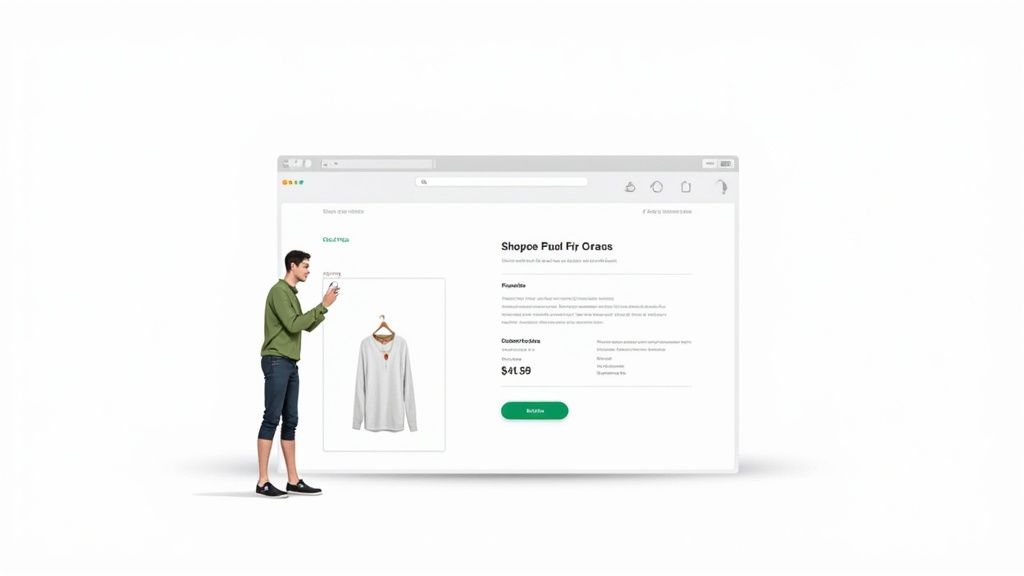
Many new store owners fall into the trap of thinking more traffic is the magic bullet for more sales. They’ll launch a big social media ad campaign, only to see a disappointing trickle of sales that doesn't come close to justifying the ad spend.
The real foundation of a profitable Shopify store is creating an experience where customers feel confident and genuinely excited to buy. This groundwork has to be laid before you start sending paid traffic.
If you really want to improve your Shopify conversion rate, you have to focus on the fundamentals first. Every single element—from your product descriptions to your site navigation—needs to be carefully crafted to guide visitors toward that "Add to Cart" button.
Craft Product Descriptions That Sell
Think of your product descriptions as your 24/7 digital salespeople. Their job isn't just to list specs; it's to tell a compelling story, solve a real problem, and connect with your customer on an emotional level.
- Focus on Benefits, Not Just Features: Instead of saying a backpack has "water-resistant fabric," explain how it "keeps your laptop and essentials safe and dry on those rainy day commutes." See the difference?
- Use Persuasive Language: Weave in words that build desire and a sense of urgency. Get to the "why" behind their purchase.
- Keep It Scannable: People skim online. Use short paragraphs, punchy bullet points, and bolded text to highlight the most important info.
My Two Cents: Get inside your ideal customer's head. What are their biggest frustrations or deepest desires? Write every description as if you're speaking directly to them, showing them exactly how your product is the answer they've been looking for.
Showcase High-Quality Product Photography
In ecommerce, your photos are your product. It’s the closest a customer can get to touching and feeling your item. Grainy, poorly lit, or generic stock photos instantly kill trust and make your brand feel cheap. This is one area where you absolutely cannot afford to cut corners.
In fact, great visuals can be the single most important factor in a buying decision. Investing in professional-looking images isn’t a luxury; it’s a core business activity that has a direct, measurable impact on your revenue. If you're looking to really level up your store, exploring options for professional Shopify product photography can give you a massive edge over the competition.
Design an Intuitive Site Structure
A confusing website is a closed website. Simple as that. If a shopper can't easily find what they're looking for within a few seconds, they'll just leave and buy from someone else. Your store's navigation needs to be simple, logical, and completely intuitive.
Organize your products into clear, understandable collections. Make sure your main menu is a no-brainer to navigate. Try to walk through your site as if you're a first-time visitor trying to find a specific item—then ruthlessly eliminate any extra clicks or confusing labels you find along the way.
It's no accident that Shopify has become a global powerhouse, now powering over 5.5 million active online stores worldwide. With a staggering 29% market share in the U.S. alone, the platform has set a new standard for user-friendly ecommerce. This widespread adoption means customers now expect a certain level of quality and ease of use. To compete, you have to meet—and exceed—that standard.
Before diving into complex marketing strategies, it's worth summarizing the low-hanging fruit. These are the foundational tweaks that can have an outsized impact on your store's performance right away.
Quick Wins for Increasing Shopify Sales
A summary of foundational strategies that have a direct impact on your store's conversion rate and overall sales performance.
| Strategy Area | Actionable Tip | Expected Impact |
| Product Presentation | Replace low-quality images with professional, high-resolution photos showing multiple angles and in-context use. | Increased trust and perceived value, leading to higher Add-to-Cart rates. |
| Site Navigation | Simplify your main menu to 5-7 clear, top-level categories. Ensure all products are logically organized. | Reduced bounce rate and improved user experience, making it easier for customers to find and buy products. |
| Copywriting | Rewrite product descriptions to focus on benefits over features. Use bullet points for easy scanning. | Stronger emotional connection with the customer, clarifying the product's value and boosting conversions. |
| Trust Building | Prominently display customer reviews, trust badges (secure checkout, money-back guarantee), and clear contact info. | Alleviated customer anxiety and increased confidence in making a purchase, directly improving the conversion rate. |
Nailing these core elements creates a solid foundation. Once your store is a well-oiled conversion machine, then you can confidently invest in driving traffic, knowing that your budget is being put to its best possible use.
Optimize Your Customer Journey to Reduce Friction
You can have the most beautiful storefront and the best products in the world, but if the path to purchase feels like an obstacle course, you're leaving money on the table. It's a simple truth. Every moment of frustration or confusion is a potential lost sale. The secret to getting more sales on Shopify often comes down to one thing: making the buying process as smooth, fast, and trustworthy as possible.
Put yourself in your customer's shoes for a second. They find a product they love, but the page takes ages to load. They finally add it to their cart, only to find the checkout form is a confusing mess on their phone. These little friction points add up, creating just enough doubt to make them leave.
Eradicate Slow Page Speeds
Page speed isn't just some technical metric for developers to obsess over; it's a direct driver of your sales. I've seen it time and time again: a one-second delay in page load times can slash conversions by 7%. For a store trying to grow, that's a killer.
So, where do you start? First, diagnose the problem. Use a tool like Google's PageSpeed Insights to get a baseline score for your key pages—don't just check the homepage, look at your collection and product pages, too. The most common culprits I see dragging down Shopify stores are:
- Bloated Images: This is the big one. Large, uncompressed photo files are the number one cause of a slow store.
- Too Many Apps: Be careful here. Every app you install can add extra code (JavaScript and CSS) that has to load, slowing everything down.
- Complex Themes: Those visually stunning themes with tons of sliders, animations, and features can be resource hogs if they aren't coded efficiently.
My Two Cents: I tell every store owner I work with to conduct a ruthless "app audit" every quarter. Ask yourself: Is this app directly contributing to sales or measurably improving the customer experience? If the answer is no, or you're not sure, get rid of it. Be merciless.
Design for Mobile First, Not Mobile-Friendly
There's a world of difference between a site that works on a phone and one that's designed for it. With well over half of all e-commerce traffic coming from mobile devices, you simply have to prioritize the small-screen experience. It's no longer optional.
This means big, tap-friendly buttons, simple navigation menus that don't require surgical precision, and product photos that pop in a vertical view. The checkout, especially, needs to be flawless on a phone. If a customer has to painstakingly type their address and credit card info into tiny form fields, they're gone.
Create a Seamless Checkout Experience
The checkout is the final hurdle. This is where your most committed buyers can drop off if they hit a snag. Cart abandonment is a massive friction point, and exploring proven strategies to reduce cart abandonment can dramatically improve your sales by smoothing out this final step.
Start with the basics: offer a guest checkout. Forcing people to create an account before they can hand you their money is a notorious conversion killer. Just let them buy the thing.
Next, make paying as easy as possible by integrating familiar and trusted payment options. Beyond standard credit cards, offering express gateways like Shop Pay, PayPal, and Google Pay is a game-changer. They allow customers to complete their purchase in just a few clicks, which is an absolute superpower on mobile.
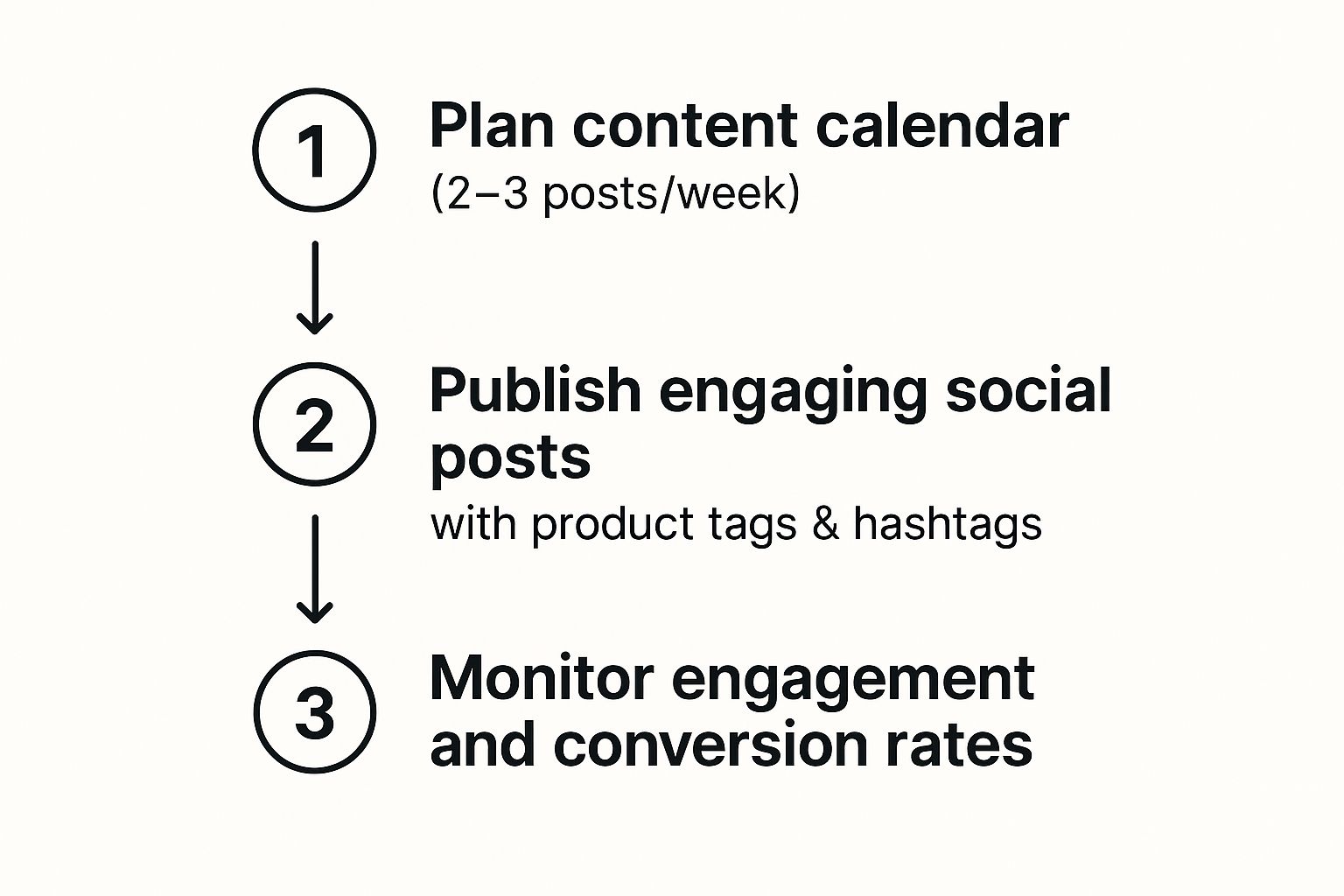
The image above outlines a simple social media workflow—plan, publish, monitor—that drives sales. The key takeaway is that successful social selling is a deliberate cycle of planning, doing, and analyzing, not just posting whenever you feel like it.
Ultimately, using data is what separates the pros from the amateurs. While checkout optimization is critical, other user experience tweaks can be just as powerful. For instance, did you know that adding a wishlist feature can capture future sales from people who aren't ready to buy today? Research shows that a staggering 40% of shoppers want a wishlist option. By carefully mapping and refining every single step of their journey, you turn your store from a simple website into a well-oiled machine built for conversions.
Attract Eager Buyers with Smarter Marketing
Okay, you've polished your Shopify store until it shines. Now what? You need to get the right people in the door—visitors who are actually looking to buy what you’re selling. Just throwing money at generic ads is a surefire way to burn through your budget with little to show for it.
The secret to boosting sales is to stop shouting into the void and start having smart conversations where your ideal customers are already hanging out. It’s not about just getting more traffic; it’s about attracting high-intent shoppers who are far more likely to click “add to cart.”
Nail Your Targeting with Meta Ads
Meta (that’s Facebook and Instagram) is still a beast for e-commerce, but you have to be clever. The real wins come from laser-focused targeting, not just pretty pictures. Forget broad categories like "women aged 25-40 who like fashion"—that's a crowded, expensive playground.
You need to dig deeper and find your micro-audiences. Think about the specific behaviors and tastes that define your true customers.
- Target by Behavior: Go after users who have recently clicked a "Shop Now" button or made an online purchase. These are active buyers.
- Layer Your Interests: Don't just target "yoga." Get specific. Target users who like "Lululemon," follow "Yoga Journal," and have shown interest in "sustainable products." See how much more powerful that is?
- Create Lookalike Audiences: This is where the magic really happens. Once you have a customer list of 100-200 people, you can ask Meta to build a "Lookalike Audience." Its algorithm will hunt down new people who share traits with your best customers. It's an incredibly effective way to scale your campaigns.
Trust me, a tiny, hyper-relevant audience of 50,000 people will consistently outperform a generic audience of two million. It’s all about quality, not quantity.
Capture Ready-to-Buy Shoppers with SEO
Paid ads get you quick bursts of traffic, but Shopify SEO is your ticket to long-term, free traffic. Think about it: when someone types a problem into Google, they have a clear need. If your product shows up as the solution, you're catching them at the perfect moment.
Getting your Shopify store to rank isn't as intimidating as it sounds. Start right on your product pages. Ask yourself, "What would a real person search for to find this?"
Then, weave those exact phrases naturally into your:
- Product titles
- Product descriptions
- Image alt text (what you'd use to describe the image to someone who can't see it)
- Page URL
For example, if you sell a "handmade leather journal," make sure that exact phrase is a core part of the page. This tells Google precisely what you offer, dramatically improving your chances of showing up when someone is ready to buy. SEO is a marathon, not a sprint, but the payoff is a steady, growing stream of the best kind of traffic: motivated buyers.
A critical mistake I see all the time is store owners ignoring SEO until they're desperate for traffic. If you build these simple SEO habits into your product listings from day one, you're creating a powerful, compounding advantage that will pay you back for years.
Build Trust (and Sales) with Content Marketing
Not every visitor is going to buy on their first visit. That’s normal. Content marketing is your strategy for engaging people earlier in their journey, earning their trust, and gently guiding them toward a purchase. It's how you go from being just another online store to being a go-to resource.
Think about the problems your products solve.
If you sell high-performance running shoes, don't just talk about the shoes. Write a blog post titled, "5 Common Running Injuries and How to Prevent Them."
Inside that article, you can naturally explain how your shoes' superior cushioning or stability control helps solve those exact problems. You're not just selling; you're helping. This approach positions your product as the obvious, helpful solution and is a proven way to get more sales on Shopify. You’re building authority and attracting your ideal customer before they even realize they need what you sell.
Use Pricing Psychology and Smart Promotions to Nudge Buyers
 Once you've got interested shoppers on your site, that final nudge toward the "buy" button often comes down to your pricing. It’s about more than just covering your costs; it’s a powerful psychological tool that can make a product feel both irresistible and urgent.
Getting this right isn't about slapping random discounts on everything. It’s about building a thoughtful promotional strategy that guides customers, making them feel like they're walking away with a fantastic deal. This is a direct path to getting more sales on Shopify.
The Power of Charm Pricing and Price Anchoring
One of the oldest tricks in the retail playbook is still one of the most effective: charm pricing. We’ve all seen it—prices that end in a nine. Our brains are simply wired to see $29.99 as significantly cheaper than $30.00, even though it's just a one-cent difference. It works because we read left-to-right, and that first digit—the "2"—anchors our perception of the price.
You can make this even more powerful with price anchoring. This is where you show a higher "original" price crossed out next to the current sale price (e.g., $50 $39). This instantly frames the offer as a bargain and creates a strong sense of value.
A quick word of caution: Be honest with your price anchoring. The "before" price has to be a price you genuinely sold the product for. Faking it can destroy customer trust and even get you into legal hot water.
Boost Your Average Order Value with Bundles
A brilliant way to increase your Average Order Value (AOV) is through product bundling. Instead of just selling one item, you can package several related products together for a single, slightly discounted price.
This works wonders. It simplifies the decision for the customer and makes them feel like they're getting more bang for their buck.
- The Starter Kit: Think about what a new customer needs to get going. A skincare brand could bundle a cleanser, moisturizer, and serum.
- The "Complete the Look" Bundle: If you sell clothes, you could bundle a popular t-shirt with matching pants and a hat.
- The Bulk Discount: For things people use regularly, like coffee or supplements, try a "buy two, get one 50% off" deal to encourage them to stock up.
Bundling not only lifts the immediate sale value but can also introduce customers to other products in your catalog they might not have tried otherwise. It’s a true win-win.
Deploy the Right Type of Discount
Not all discounts hit the same. The two most common types are percentage-off deals (e.g., 20% off) and flat-dollar discounts (e.g., $10 off). The trick is knowing when to use each for the biggest psychological impact.
A great rule of thumb is the "Rule of 100."
- If your product costs less than $100, a percentage discount usually feels like a bigger deal (e.g., 25% off a $40 item sounds more impressive than $10 off).
- If your product costs more than $100, a flat-dollar discount often seems more significant (e.g., $50 off a $200 item feels more substantial than 25% off).
And don't forget about free shipping. It's one of the most powerful motivators out there. Study after study shows that unexpected shipping costs are a top reason people abandon their carts. Offering free shipping, especially over a certain amount (like "Free Shipping on Orders Over $75"), is a fantastic way to remove that friction point and bump up your AOV.
Create Real Urgency Without Being Spammy
Urgency gets people to act, but it has to feel genuine. If you're always running a "24-Hour Flash Sale," customers will quickly learn to just ignore you. The key is to use scarcity and time-sensitivity in ways that make sense.
- Low Stock Alerts: Use Shopify apps to display messages like "Only 3 left in stock!" on product pages. This acts as social proof, showing the item is popular and creating a real fear of missing out.
- Limited-Time Offers: Tie your sales to specific holidays or events, like a "Weekend Father's Day Sale." The deadline is real and justifiable.
- Tiered Discounts: Offer a discount that shrinks over a few days (e.g., 25% off Friday, 20% off Saturday, 15% off Sunday). This rewards the early birds and gives everyone a clear reason to buy now rather than later.
By thoughtfully combining these pricing and promotion tactics, you can create a compelling story around your offers. Of course, even the best deals fall flat without great visuals. To explore creating stunning images that make these promotions pop, check out ProdShot's flexible product photography pricing plans designed for any e-commerce store.
Use Data to Fuel Your Continuous Growth Engine
Getting traffic to your store is just one piece of the puzzle. The real magic—and sustainable growth—happens when you dig into what those visitors do once they arrive. Your Shopify Analytics dashboard is an absolute goldmine, but it's easy to get lost in vanity metrics like total visitors.
To actually move the needle and get more sales, you have to shift your perspective. Stop obsessing over how many people visit and start analyzing what your best customers do. This is how you stop guessing and start building a business that gets smarter with every sale.
Identify Your True Winners
Let’s be honest: not all of your products are created equal. Buried in your analytics is the answer to one of the most important questions you can ask: Which products are really making you money?
Don't just glance at total units sold. A high-volume, low-margin product might seem like a star, but a less popular item with a huge margin could be your real workhorse. The place to find this out is your "Sales by product" report in Shopify Analytics.
Zero in on these metrics:
- Net Sales: This is your revenue after discounts and returns. It gives you a far more accurate picture of a product's true financial contribution than gross sales ever could.
- Units Sold: This is still crucial for understanding demand and keeping your inventory in check.
- Product Conversion Rate: Of all the people who view a specific product page, how many actually buy it? This tells you which products have the most persuasive listings.
Once you know your most profitable items, you have a clear roadmap for your marketing. Feature them on your homepage, build ad campaigns around them, and create blog posts that show them off.
So many store owners make the mistake of promoting the product they personally love the most. You have to let the data show you what your customers love. The answer is often surprising and can uncover revenue you didn't even know was there.
Understand Your Most Valuable Traffic Sources
Just like your products, not all traffic sources deliver the same value. A flood of views from a viral TikTok might feel great, but if it doesn’t lead to sales, it’s mostly just noise. The goal isn't just traffic; it's traffic that buys.
Your "Sales by traffic source" report is where you find your marketing roadmap. This report cuts through the clutter and shows you exactly where your paying customers come from—whether that's direct visits, social media, organic search, or paid ads.
Imagine you look at your report and see that your blog posts are driving a 4.5% conversion rate, but your Facebook ads are sitting at a measly 1.2%. That's not a failure; it's a crystal-clear signal. It’s telling you to pour more resources into content marketing or to completely rethink your ad creative and targeting. This is how you double down on what’s working and stop wasting money on what isn't.
Build a Simple Data Feedback Loop
The most successful Shopify stores I've seen all run on a simple but powerful cycle: Test, Measure, Iterate. This is the core of making your store smarter and more profitable over time. Don't be intimidated by the term "data analysis"—it can be incredibly straightforward.
Here’s how it works in practice:
- Start with a question. It all begins with a hypothesis. For example: "I bet if we offered free shipping on orders over $50, our Average Order Value (AOV) would go up."
- Run the test. Go for it. Put that free shipping banner on your site and let it run for a defined period, like two weeks.
- Check the results. After the two weeks are up, dive back into your analytics. Did your AOV actually increase? What happened to your overall conversion rate? And crucially, how did it impact your profit margins?
- Decide and do it again. If the test was a home run (say, your AOV jumped 15%), lock it in as a permanent feature. If it flopped or hurt your margins, kill it and move on to the next idea.
This loop takes the ego and emotion out of running your business. It doesn't matter what you think will work. All that matters is what the data proves.
Of course, even the best strategies need incredible visuals to close the deal. To make sure your winning products look as good as they perform, using professional photo editing services for ecommerce can give you that polished, conversion-ready edge.
Frequently Asked Questions About Increasing Shopify Sales
As you start putting these strategies into action, you're bound to run into a few common questions. Every store owner hits these same forks in the road, so let's clear up some of the most frequent sticking points.
Think of this as a quick chat to tackle the practical questions that pop up when you're laser-focused on getting more sales.
How Quickly Can I See an Increase in Sales?
This is the big one, and the honest-to-goodness answer is: it really depends on what you do. The timeline for seeing more sales is tied directly to the tactics you choose to implement.
You can break it down into two buckets:
- Short-Term Wins (Days to Weeks): Some things can give you an almost immediate lift. Running a flash sale, simplifying your checkout with something like Shop Pay, or firing up a sharp abandoned cart email sequence can all bring in new sales within days.
- Long-Term Growth (Months): Other strategies, like SEO and content marketing, are more like planting a tree. You won't see a massive jump in organic traffic overnight, but give it a few months, and this approach starts delivering highly qualified, "free" traffic that just keeps growing.
The smartest store owners do both. Use the quick wins for immediate cash flow and to build momentum, but never stop investing in those long-term strategies that create stable, predictable growth down the line.
What Is the Most Common Mistake Shopify Store Owners Make?
I've seen this time and time again: the single biggest mistake is driving traffic to an unoptimized store. It's a classic case of putting the cart before the horse.
Countless merchants get excited about a new ad campaign, pour their marketing budget into it, and send a flood of visitors to a site with glaring issues. They're paying for ads while completely ignoring slow page speeds, a confusing menu, bad product photos, or a clunky checkout process. The result? High traffic numbers, depressingly low conversion rates, and a lot of wasted ad spend.
Always build a solid, high-converting foundation before you crank up the traffic. Your marketing dollars will go so much further when every visitor lands on a site that's actually built to sell.
Do I Need Expensive Shopify Apps to Get More Sales?
Not at all, especially when you're just starting out. The Shopify App Store is an incredible resource, but it's also a place where it's dangerously easy to overspend. You can get surprisingly far just by mastering the features Shopify already gives you.
Before you go on an app-installing spree, focus on the fundamentals:
- Telling a great product story in your descriptions.
- Using high-quality images that show value and build trust.
- Nailing your on-page SEO to start capturing search traffic.
- Building an email list from day one.
Start with free or low-cost apps for the absolute essentials, like collecting customer reviews or adding a simple email pop-up. You should only pay for an app when you've hit a specific wall in your business that a specialized tool can break through. That way, you know you'll get a clear return on the investment.
Should I Focus on New Customers or Existing Ones?
This is a classic tug-of-war, but for most stores, the answer is to put more energy into retention. Why? Because selling to your existing customers is so much cheaper and easier.
It can cost up to five times more to acquire a brand-new customer than it does to keep a current one happy. Think about it: your existing customers already know your brand, trust your quality, and have proven they're willing to buy.
That's why you should prioritize strategies that boost Customer Lifetime Value (CLV). This includes things like:
- Sending targeted emails with personalized offers.
- Creating a simple loyalty program to reward repeat business.
- Following up after a purchase to suggest complementary products.
A healthy ecommerce business finds the right balance between attracting new people and nurturing the loyal customers you've already won.
While these FAQs cover some common ground, every store’s journey is different. For a deeper look, check out this complete playbook on how to increase Shopify sales, which offers even more detailed tactics for modern store owners.